
Every company, whatever its size, faces the same challenge: improving team cohesion. Team building is the most appropriate answer to it.
Whether the issue is internal communication, cohesion, tension, or simply new people joining the company, team building is what improves relationships between employees.
What is team building?
Team building is a concept that appeared at the end of the 1980s, following studies into the correlation between a team’s dynamic and its performance at work. In other words, the atmosphere within a team has an effect on its productivity.
That is how the first team-building events came about.
The aim is to let a company’s employees carry out activities as a group in order to reach a shared, non-professional objective. It strengthens team spirit and gives employees the chance to know each other away from the workplace. It is also an opportunity to pass on the company’s values in an enjoyable way.
What are the benefits of team building?
Team building has a number of advantages.
Beyond being a participatory event that strengthens cohesion and improves communication within the company, it motivates employees, which has a direct effect on the quality of their work.
This rests on the work of Elton Mayo (1880–1949), one of the precursors of the sociology of work. He studied the American Western Electric factory to demonstrate the link between workers’ satisfaction and their productivity. He showed that a worker who is more valued, and more involved in the company’s decisions, tends to invest more in their work.
It can also be an opportunity to settle tensions between colleagues that would otherwise obstruct productivity.
Some team-building ideas
Team-building activities differ according to the type of company. A firm of more than 1,000 employees and a startup of 10 people cannot run the same kind of team building, because their company cultures differ.
The aim, though, stays the same: bringing employees closer, whatever their role and whatever their age.
Here are 10 activity ideas for a team building that works.
The escape game
What better way to get employees collaborating towards a single goal?
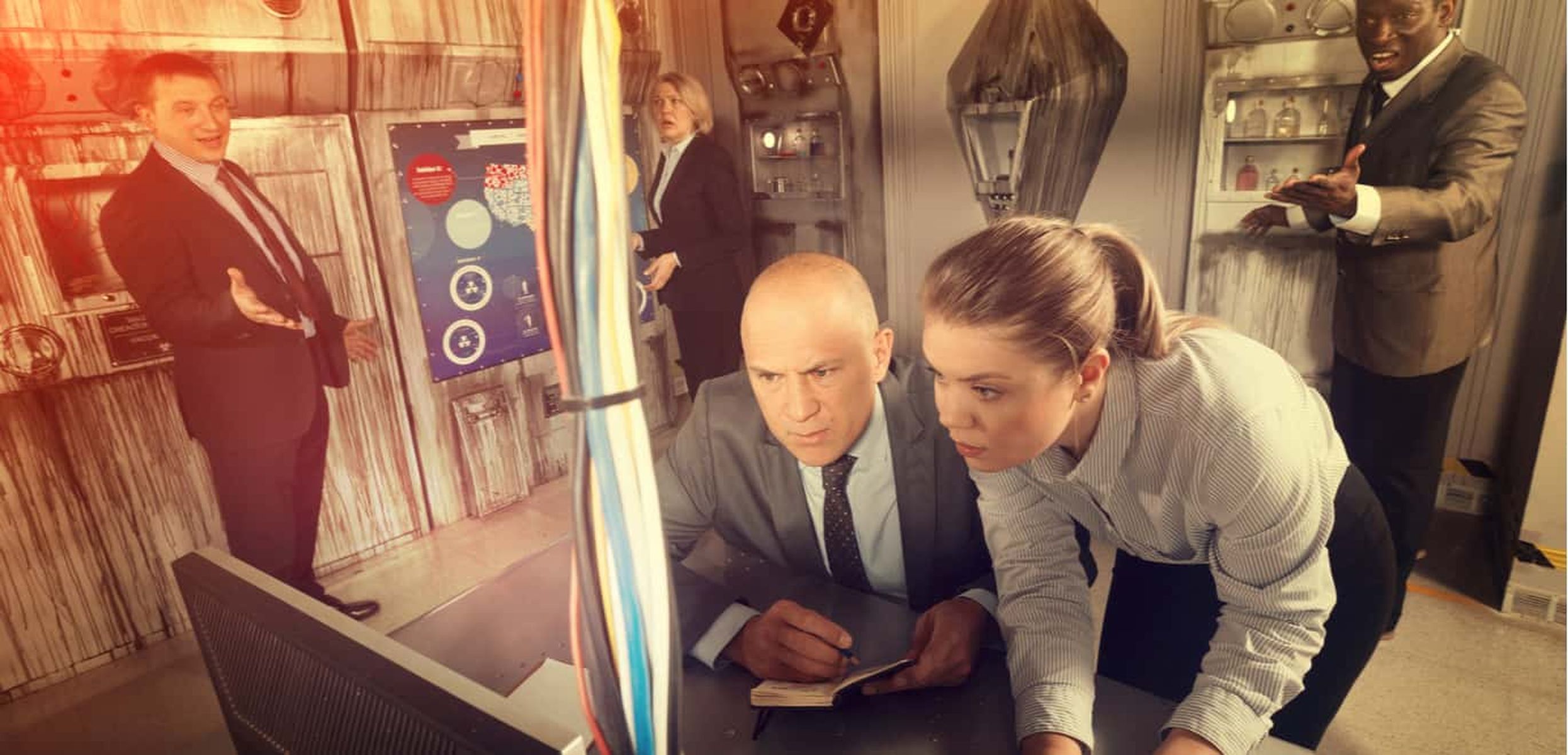
As a team, you are locked in a room and have to solve clues hidden around it in order to get out. You generally have 60 minutes, after which the doors open automatically if you have not found the way out.
Escape games traditionally run in small groups of three to five people, though some venues take up to 12. Choose the option that suits the size of your company.
Inside the room you may handle anything in order to find the clues that let you out — but take care not to break anything.
An escape game costs around 20 euros per player and gives your employees a memorable experience alongside their colleagues.
The treasure hunt
This gives employees a shared objective and makes them work as a team, which benefits cohesion within the company.

Divide employees into teams. It matters that the teams are assigned rather than chosen, so that people mix with colleagues they do not normally work alongside.
A treasure hunt also requires considerable organisation.
First, set a theme. It can follow your field of work, or you may prefer to step outside the professional context entirely.
Next, decide what the stages will be. They might be puzzles on the chosen theme, a physical challenge, or answering a question about a colleague, as an enjoyable way to learn more about each other.
Finally, choose the prize and where to hide it. A hamper the employees can share at the end of the activity works well.
Shooting a short film
This is an effective way to get colleagues working as a group towards a shared objective: making a short film.

Here again, you form teams.
There are two ways to make the film:
- Use a specialist studio that helps each team make their film.
- Make it with what you have: phones or cameras.
To make the activity more interesting, give the employees a theme to work to.
You might also run a competition for the best short film to give the day more energy.
Running a blind test
This lets the music enthusiasts share what they love.
It is an activity you can run on your own premises or in a bar, for a more relaxed atmosphere. Book a room so that you have space and can play your own music.
A blind test guarantees a good atmosphere. Play music across a range of styles and everyone will find something, and be able to sing and dance to their favourite song.
The advantage of the blind test is that it needs little preparation and costs little. It is an activity you can run regularly, and it lets all your employees spend good time together.
Running a karaoke
Karaoke is a good way to discover what people can do.

Many will not dare go on stage alone, which encourages singing groups to form.
To run your karaoke, you can hire a room in a bar, as with the blind test. Many offer rooms with a stage, a microphone and a projector — everything you need for a good evening.
Alternatively, karaoke can take place on company premises, with a karaoke kit including a song disc and a microphone.
Karaoke also lends itself to variations. You might run your own version of The Voice, or a voice-recognition contest, in which one person sings while another, with their back to the stage, has to identify which colleague the voice belongs to.
Mini-olympics
This activity consists of small challenges that teams take on to score as many points as possible. The possibilities are effectively unlimited. It is best held outdoors, in a park for instance, since some challenges involve water, which is less suitable on company premises.
Some challenge ideas:
- The sack race: participants race with their legs inside a sack, so they have to jump to the finish line.
- The pyramid: players build a human pyramid. The first team to manage it wins.
- The water fight: each team tries to soak every player on the other team.
- The blindfold race: participants race with their eyes covered.
- Drinking a glass of water without hands: the team with the most players who manage it without spilling wins.
Mini-olympics are an enjoyable, active way to get to know your colleagues.
Running a selfie competition

Alone or in groups, invite employees to photograph themselves in unusual places. Then run a competition to choose the best photograph.
This kind of activity lets everyone show a side of themselves to colleagues outside a professional setting, so employees can get to know each other away from work.
It can take place outside the company, in a park for example, or on the premises. The second option can be a good way to turn the workplace into somewhere enjoyable for a few hours.
The WeChain photo activity suits this exercise particularly well, not least because it can project an interactive mosaic of the attendees’ photographs, forming a picture or a logo, onto a large screen. Useful for maintaining a sense of community.
Murder party
Invite your team to solve a crime.

It is a kind of Cluedo in real life. You need:
- a victim
- suspects and a culprit. It is best to organise the activity with several people, so that each organiser can play a suspect and be questioned by the participants
- detectives, played by the employees.
Improvisation
Give your colleagues’ imagination free rein.
Divide players into teams. Prepare several improvisation themes, so that each team draws one at random and then has around five minutes to prepare.
To make the activity more entertaining, you can impose constraints, such as:
- The piece must be silent
- Absurd invented words must be used
- The sketch must contain a song
This activity lets colleagues perform in front of people they do not necessarily know, which establishes a relationship of trust from the first encounter.
Laser tag
This activity brings out the competitive streak in some people.

What is laser tag? It is a game in which several teams compete in a simulated shooting contest. The aim is to score as many points as possible by hitting your opponents with a laser beam, while avoiding being hit yourself.
You carry a gun connected to a vest you wear. When you hit an opponent, or take a hit yourself, the screen on your gun shows who shot you or who you hit.
At the end of the game the winning team is announced, and you receive a printout with each player’s statistics. You can see who the best shot was and who hit you most often.
The activity lets everyone let off steam in good spirits and give their best.
Organising these activities can be given to the company’s HR or event communication department. A good many event agencies also specialise in team building and will put together activities your employees are not likely to forget.
In conclusion, team building strengthens relationships between a company’s employees.
It is also an opportunity to pass on the company’s values and make the workplace more enjoyable.